API Security Review: A Developer's Complete 2026 Guide
API Security Review: A Developer’s Complete 2026 Guide

An API security review is the systematic evaluation of API endpoints to identify vulnerabilities, misconfigurations, and authorization flaws before attackers exploit them. For developers and tech teams, this process is the primary defense against data breaches caused by insecure APIs. Structured around the 2023 OWASP API Security Top 10, a proper review combines static analysis, dynamic testing, fuzzing, and manual penetration testing into one layered methodology. Skipping any layer leaves blind spots that automated tools alone cannot close.
What are the core vulnerabilities covered in an API security review?
The 2023 OWASP API Security Top 10 defines the threat categories every API security audit must address. These risks are not theoretical. They represent the attack patterns most commonly exploited in real production environments.
| Vulnerability | Definition | Potential Impact |
|---|---|---|
| Broken Object Level Authorization (BOLA) | Attacker accesses another user’s data by manipulating object IDs | Unauthorized data exposure |
| Broken Authentication | Weak or missing token validation allows impersonation | Account takeover |
| Broken Object Property Level Authorization | Excess data returned beyond what the caller should see | Sensitive data leakage |
| Unrestricted Resource Consumption | No rate limiting on requests | Denial of service, cost overruns |
| Security Misconfiguration | Permissive CORS, missing headers, verbose error messages | Unauthorized access, data leakage |
| Server-Side Request Forgery (SSRF) | API fetches attacker-controlled URLs | Internal network exposure |
| Improper Inventory Management | Shadow or deprecated endpoints left active | Unpatched attack surface |

BOLA is the most frequently exploited vulnerability in modern APIs. It is also the hardest to catch with automated scanners because the flaw lives in business logic, not code syntax. Security misconfigurations like permissive CORS and missing security headers are far more common than most teams expect. They expose APIs to unauthorized access and data leakage without any sophisticated attack required.
The OWASP API Security Testing Framework covers 12 test cases, including protocols like GraphQL and gRPC, not just REST. That scope matters because many teams only test their primary REST endpoints and leave GraphQL introspection or gRPC reflection endpoints wide open.
How is a comprehensive API security review conducted?
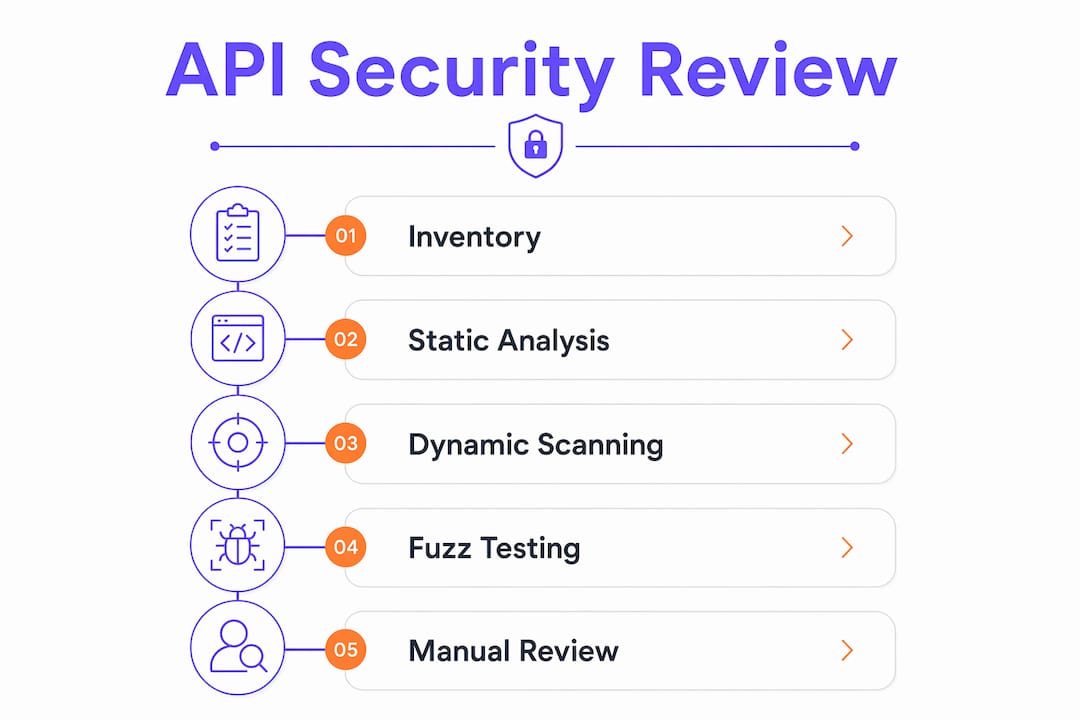
A thorough API security assessment uses four distinct testing layers. Each layer catches a different class of vulnerability. Skipping one means accepting a category of risk.
-
Static Application Security Testing (SAST). SAST analyzes source code and API definitions before the application runs. It catches hardcoded credentials, insecure configurations in OpenAPI specs, and missing input validation rules. SAST runs during development, which makes it the cheapest layer to operate.
-
Dynamic Application Security Testing (DAST). DAST sends live requests to a running API and observes responses. It detects issues like verbose error messages, missing authentication enforcement, and improper HTTP method handling. DAST tools like OWASP ZAP and Burp Suite are the workhorses of most API vulnerability testing programs.
-
Spec-based fuzzing. Fuzzing generates malformed, unexpected, or boundary-case inputs based on your OpenAPI or GraphQL schema. Tools like Schemathesis automate this process and surface crashes, unexpected 500 errors, and input validation gaps that DAST misses. Automated scanners cover over 100 rules across 22 categories and can verify compliance with PCI-DSS v4.0, GDPR, HIPAA, and DORA.
-
Manual penetration testing. Manual review is the only method that reliably detects business-logic flaws. Automated tools lack the context to understand what a sequence of API calls is supposed to do versus what it actually does. A skilled tester can chain together individually valid requests to achieve unauthorized outcomes that no scanner would flag.
The right cadence combines all four layers. Automated SAST and DAST run in every CI/CD pipeline build. Fuzzing runs on every significant schema change. Manual penetration testing runs on a scheduled basis, at minimum quarterly, and after any major feature release.
Pro Tip: Integrate SAST and DAST into your CI/CD pipeline from day one. Shift-left security catches vulnerabilities when they cost minutes to fix, not weeks.
What practical steps help ensure an effective API security review?
Methodology matters, but execution determines results. These are the steps that separate a thorough API security audit from a checkbox exercise.
-
Build a complete API inventory first. API inventory discovery maps every active, shadow, and deprecated endpoint. Without this map, your audit has gaps by definition. Shadow APIs, those created by developers outside the formal release process, are frequently the most vulnerable because they receive no security scrutiny.
-
Configure role-based testing contexts. Supply your scanners with legitimate roles and tokens for every user type your API supports. A scanner running as an anonymous user will miss every authorization flaw that only appears when a low-privilege user tries to access a high-privilege resource.
-
Load your OpenAPI or GraphQL schema into your tools. Schema-aware scanners generate far more relevant test cases than blind crawlers. They know which parameters exist, what types they expect, and which endpoints require authentication.
-
Test after every significant change. Vulnerabilities can appear within minutes when a developer pushes a change to authentication, authorization, or data logic. Waiting for a quarterly review after a daily deployment cycle is not a security program. It is a gap.
-
Do not skip business-logic testing. The most damaging API breaches exploit logic flaws, not missing headers. A scanner will confirm your rate limiting header exists. It will not confirm that your rate limiter actually blocks an attacker who rotates IP addresses.
Pro Tip: Run your API inventory discovery tool against your production environment, not just staging. Developers frequently deploy endpoints to production that never appear in staging documentation.
Common pitfalls to avoid:
- Scoping the audit to documented endpoints only
- Running scanners without authentication tokens
- Treating a passed automated scan as a security clearance
- Ignoring deprecated API versions still accessible in production
Which tools and frameworks support API security reviews?
Most teams combine multiple tools to cover different testing needs and API protocols. No single tool handles every layer of an API security assessment.
| Tool | Type | Open Source | Best Use Case |
|---|---|---|---|
| OWASP ZAP | DAST | Yes | Automated scanning for REST APIs |
| Burp Suite | DAST + Manual | Community free / Pro paid | Manual penetration testing |
| Postman | Manual + Automation | Free tier available | Functional and auth testing |
| Schemathesis | Fuzzing | Yes | Schema-based fuzz testing |
| 42Crunch | Static + DAST | No | OpenAPI spec auditing and CI/CD |
OWASP ZAP is the standard entry point for teams new to API vulnerability testing. It handles REST APIs well and integrates with most CI/CD platforms. Burp Suite is the tool of choice for manual penetration testers because its proxy and repeater features let testers manipulate requests with precision.
Schemathesis deserves more attention than it typically gets. It reads your OpenAPI or GraphQL schema and generates hundreds of test cases automatically, including edge cases your developers never considered. For teams running GraphQL or gRPC APIs, schema-aware fuzzing is not optional. The OWASP API Security Testing Framework explicitly covers GraphQL and gRPC test cases for this reason.
Tool selection should follow your API type and team structure. A small startup running a REST API benefits most from OWASP ZAP plus Postman collections for auth testing. An enterprise team with GraphQL and gRPC services needs Schemathesis for fuzzing and Burp Suite for manual review. 42Crunch fits teams that want deep OpenAPI spec validation baked into their pipeline.
Key Takeaways
A complete API security review requires layered testing across static analysis, dynamic scanning, fuzzing, and manual penetration testing, anchored to the 2023 OWASP API Security Top 10.
| Point | Details |
|---|---|
| Start with API inventory | Map every active, shadow, and deprecated endpoint before testing begins. |
| Layer your testing methods | Combine SAST, DAST, fuzzing, and manual testing to cover all vulnerability classes. |
| Automate in CI/CD | Integrate automated scans into every build to catch vulnerabilities at the source. |
| Configure role-based contexts | Supply scanners with valid tokens for every user role to detect authorization flaws. |
| Manual testing is non-negotiable | Business-logic flaws require human testers. Automated tools cannot detect them reliably. |
Why I think most teams are doing API security wrong
After working through dozens of API security assessments, the pattern I see most often is teams that treat automation as a destination rather than a starting point. They run OWASP ZAP, get a clean report, and ship. That is not a security program. That is a false sense of confidence.
The vulnerabilities that cause real damage, BOLA, privilege escalation, insecure direct object references, do not show up in automated scan reports. They require a tester who understands your business logic well enough to ask “what happens if I call this endpoint as User A but request User B’s data?” Scanners do not ask that question. They confirm headers exist.
The other mistake I see constantly is poor API inventory hygiene. Teams audit their documented v2 API and forget they still have a v1 endpoint running in production that was never formally deprecated. Attackers do not forget. They find it with a basic enumeration scan in minutes.
The shift-left movement is genuinely valuable, but it has a side effect. Teams integrate security into CI/CD and then stop thinking about it. Security in the pipeline catches known patterns. It does not catch novel business-logic abuse. The mature approach treats CI/CD automation as the floor, not the ceiling. Manual assessments, run by testers who understand your domain, are what push you above that floor.
Emerging API protocols like gRPC and GraphQL add another layer of complexity. Most teams have solid REST testing practices and almost no GraphQL-specific testing. GraphQL introspection alone can expose your entire data model to an unauthenticated caller. That is not a hypothetical. It is a default configuration issue that ships in production regularly.
— Zerak
How Fnvibes strengthens your API security review process
Automated scans catch the obvious issues. The critical flaws, hardcoded keys, authorization bypasses, and logic errors, require a senior developer who knows what to look for.
Fnvibes connects your GitHub repository with experienced senior reviewers who perform the kind of manual analysis that scanners cannot replicate. The review process covers authorization flaws, insecure configurations, and code-level vulnerabilities that slip through automated pipelines. For indie developers and startup teams shipping without a dedicated security engineer, Fnvibes provides the senior perspective that catches critical issues before they reach production. The expert reviewers on the platform specialize in exactly the business-logic and authorization issues that define modern API risk.
FAQ
What is an API security review?
An API security review is a systematic evaluation of API endpoints to identify vulnerabilities like broken authentication, authorization flaws, and misconfigurations. It combines static analysis, dynamic testing, fuzzing, and manual penetration testing.
How often should teams run an API security audit?
Automated scans should run in every CI/CD build. Manual penetration testing should occur at minimum quarterly and after any major change to authentication, authorization, or data logic.
What does the OWASP API Security Top 10 cover?
The 2023 OWASP API Security Top 10 covers critical risks including Broken Object Level Authorization, Broken Authentication, Unrestricted Resource Consumption, SSRF, and Improper Inventory Management, across REST, GraphQL, and gRPC APIs.
Can automated tools replace manual API security testing?
Automated tools cannot replace manual testing. Business-logic vulnerabilities, including BOLA and privilege escalation, require human testers who understand the application’s intended behavior.
What is the first step in an API security assessment?
The first step is building a complete API inventory. Without mapping every active, shadow, and deprecated endpoint, any security audit will have gaps in its coverage.